


Making Smarter IT Budgeting Decisions in a Changing Landscape
IT budgeting is no longer just about approving infrastructure projects or managing software costs—it’s a strategic function that balances innovation with financial efficiency.
For organizations investing in new technology, cloud services, or infrastructure upgrades, understanding Capital Expenditures (CapEx) vs. Operating Expenditures (OpEx) is essential. The classification of expenses impacts cash flow, tax treatment, scalability, and long-term financial flexibility.
This guide explores how businesses can effectively manage CapEx and OpEx to maximize IT investments while maintaining agility in an evolving digital landscape.
CapEx vs. OpEx: What’s the Difference?
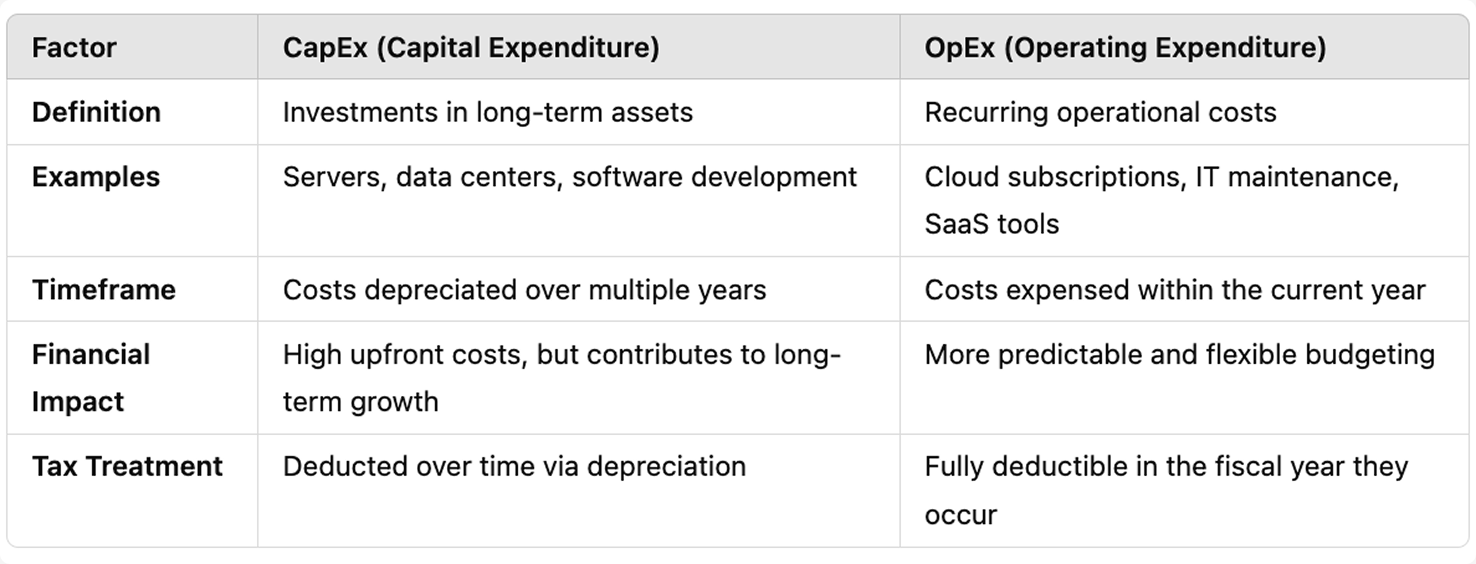
CapEx and OpEx serve distinct financial functions, and understanding their differences is crucial for informed IT investment decisions.
Why It Matters: The Financial Impact of IT Expense Classification
The way IT expenses are classified directly influences:
Budget Flexibility
- OpEx provides greater agility and adaptability to business needs.
- CapEx builds long-term assets but requires careful planning.
Cash Flow Planning
- CapEx demands significant upfront investment.
- OpEx spreads costs over time, easing cash flow constraints.
Tax Implications
- CapEx expenses are capitalized and depreciated.
- OpEx is immediately deductible, reducing taxable income.
When to Use CapEx vs. OpEx for IT Investments
Each organization must determine the right mix based on business goals, scalability needs, and financial strategy.
Use CapEx When:
- Investing in long-term infrastructure (on-premise servers, data centers, enterprise software).
- Developing proprietary software for internal use over multiple years.
- Purchasing high-value IT equipment with a long lifespan.
- Optimizing tax benefits through depreciation over time.
Use OpEx When:
- Adopting cloud-based services with predictable monthly costs.
- Scaling IT infrastructure on demand via SaaS, IaaS, or PaaS.
- Reducing upfront capital commitments for financial flexibility.
- Maintaining IT systems through ongoing software licensing, support, and updates.
Example Scenario: CapEx vs. OpEx in IT Infrastructure Decisions
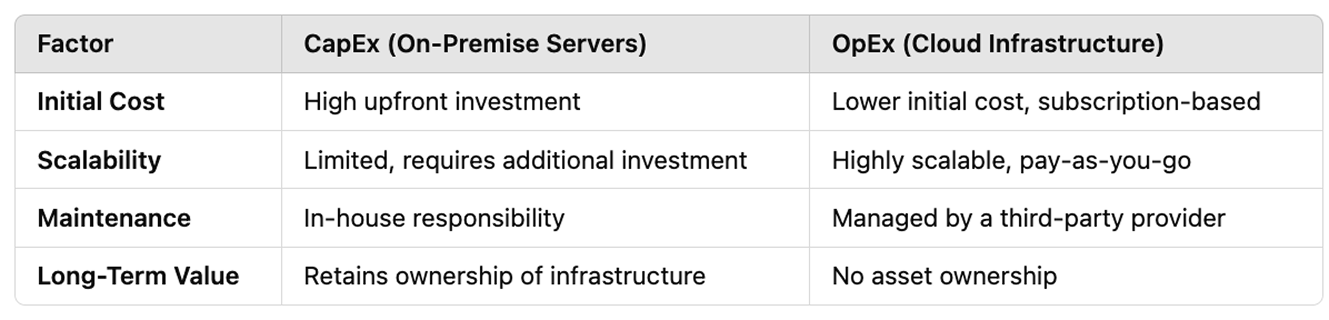
A company deciding between buying on-premise servers (CapEx) or using cloud infrastructure (OpEx) must weigh:
Decision Impact:
- A startup or a rapidly growing company might prioritize OpEx for cost flexibility and scalability.
- A large enterprise with strict data security and compliance needs may lean toward CapEx for infrastructure control.
Common Pitfalls in IT Budgeting—And How to Avoid Them
Many organizations struggle to balance CapEx and OpEx effectively. Here’s how to sidestep costly mistakes:
1. Overcommitting to CapEx Without Future-Proofing
- The Problem: Investing heavily in on-premise infrastructure that becomes obsolete within a few years.
- The Solution: Adopt a hybrid approach—use CapEx for core infrastructure and OpEx for scalable cloud services.
2. Underestimating Total Cost of Ownership (TCO)
- The Problem: Focusing only on the purchase price while ignoring maintenance, upgrades, and staffing costs.
- The Solution: Calculate full lifecycle costs before making purchasing decisions.
3. Not Tracking IT Expenses with Enough Granularity
- The Problem: Poor visibility into which departments or projects drive IT costs.
- The Solution: Use cost tracking and allocation tools to monitor IT spending in real-time.
4. Ignoring Scalability Needs
- The Problem: Investing in rigid IT infrastructure that doesn’t adapt to business growth.
- The Solution: Consider OpEx-based cloud solutions for on-demand scalability.
Best Practices for IT Budget Optimization
1. Align IT Investments with Business Goals
- Every tech purchase should support long-term strategic objectives, not just short-term fixes.
2. Leverage Cost Tracking for Smarter Decision-Making
- Implement clear expense categorization between CapEx and OpEx.
- Track IT labor costs to capitalize development work appropriately.
3. Evaluate Subscription Costs Regularly
- Audit software licenses to eliminate unused applications.
- Implement cloud cost optimization strategies to right-size OpEx expenditures.
4. Maintain a Flexible IT Budget
- Adopt a hybrid CapEx/OpEx approach for stability and agility.
- Adjust budget allocations as technology and business needs evolv
Final Thoughts: Future-Proofing Your IT Budget
To stay competitive, IT and finance leaders must adopt flexible, data-driven budgeting strategies. CapEx and OpEx aren’t just costs—they’re strategic tools that shape digital transformation and financial stability. Optimizing IT spend ensures agility, efficiency, and long-term growth.
Smarter IT Budgeting with ClickTime
Manage CapEx and OpEx with real-time tracking, financial insights, and cost control using ClickTime.