


When you get home from the office, there's no way you'd check your work email — right? Or spend Sunday afternoon getting ready for what is certain to be a crazy Monday morning?
As we become increasingly connected to — and dependent on — our phones and laptops and other devices, it can be difficult, if not almost impossible, to step away from work. And it has fundamentally changed how we interact with our colleagues, family, and friends, and changed how we define ourselves and our role in the world around us.
Earlier this week,Facebook Co-Founder Dustin Moskovitz shared his thoughts on long work weeks and how they affect employee productivity.
His take: Anything beyond 40-50 hours per week becomes problematic.
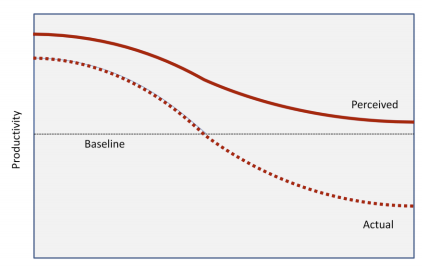
As work hours increase, employees become less productive than they perceive themselves to be.
FromMoskovitz's post:
Many people believe that weekends and the 40-hour workweek are some sort of great compromise between capitalism and hedonism, but that's not historically accurate. They are actually the carefully considered outcome ofprofit-maximizing research by Henry Fordin the early part of the 20th century. He discovered that you could actually get more output out of people by having them work fewer days and fewer hours. Since then, other researchers havecontinued to study this phenomenon, including in more modern industries like game development.
Of course, the amount of hours employees spend working varies greatly country by country, and even city by city. And the nature of those hours — the amount of stress they bring with them — ranges from the extreme focus of a surgeon or deployed armed service member to the relative calm (and possible boredom) of a ticket taker at a movie theater.
So yes, we can look at the global or national labor landscape. We can see trends and patterns, and measure change over time, but what we're missing are the unique stories the behind the numbers. It's possible that some businesses may see an increase in employee productivity during long work weeks — at least in the short term. Others may develop a culture that supports longer work weeks. Or be part of an industry with high turnover and a perceived disregard for long hours.
It's why tracking time can be so valuable. When combined with data on employee costs, revenue, and efficiency, it provides context as to whether or not your organization is demanding too many hours from your employees.
Disconnecting from work is not going to get any easier. And the national headlines of "We Work Too Much!" are certainly here to stay. But with the right data, specific to your organization, we can at least know how meaningful our time is — where it's being spent — and the impact we have on keeping the business profitable and on track.
Let's just hope it doesn't take 60 hours a week to do so.